Overgrown Pastures
Reclaim fields that haven't been mowed in a season or two. Cut down tall grass and weeds to improve grazing and pasture quality.
Our rotary cutter handles large fields, pastures, and overgrown lots efficiently. Seasonal maintenance contracts available for landowners who need regular mowing throughout the growing season.
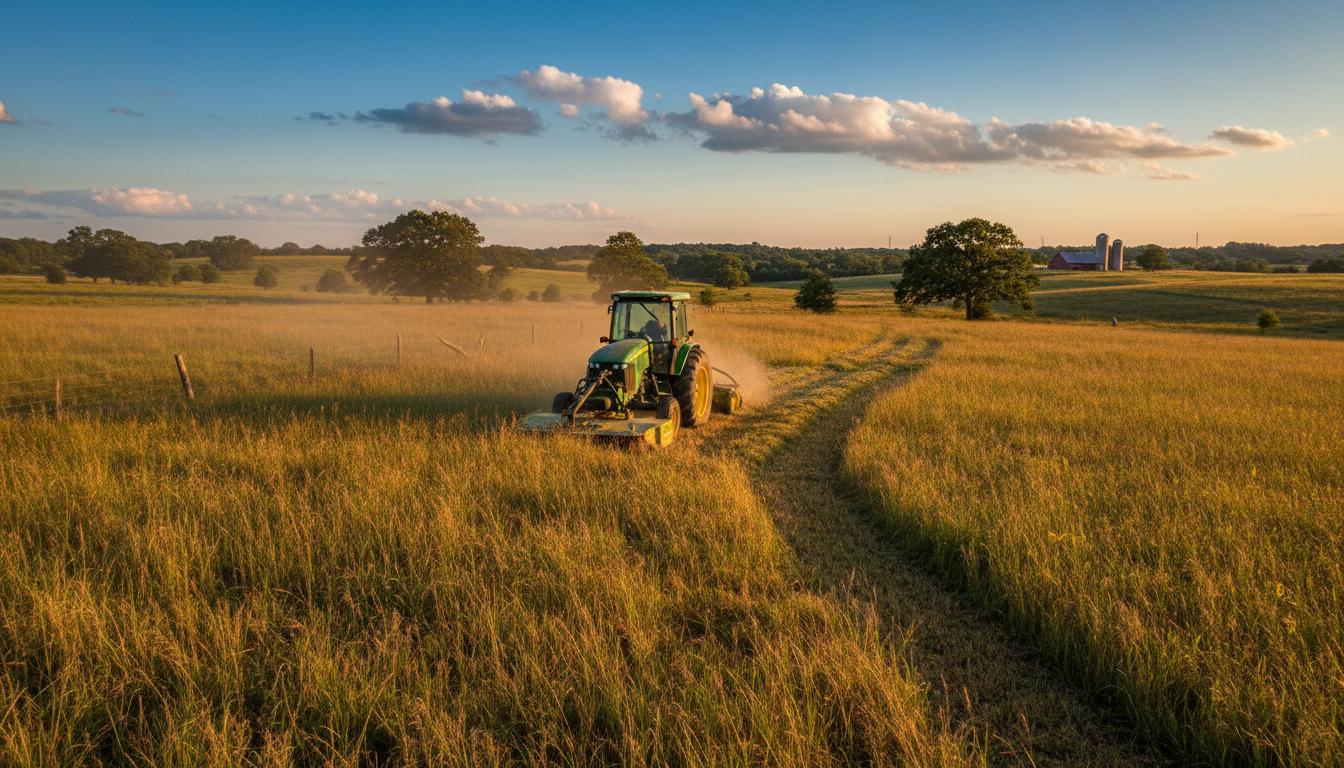
Bush hogging (also called "brush hogging" or "rotary cutting") uses a tractor-mounted rotary cutter to mow through thick grass, weeds, saplings, and light brush. Unlike a standard lawnmower, a bush hog is built for heavy-duty cutting — it handles material up to 2 inches in diameter without bogging down.
The term "bush hog" actually comes from the Bush Hog brand of rotary cutters, which became so ubiquitous that the brand name became generic — much like "Kleenex" for tissues. The proper industry term is "rotary cutting," but "bush hogging" is what Gulf Coast homeowners ask for.
A typical bush hog has a cutting width of 5–7 feet and operates at heights from 1–12 inches above ground. For residential properties, we typically cut at 3–4 inches — low enough to look maintained but high enough to avoid scalping uneven terrain or hitting hidden debris.
Reclaim fields that haven't been mowed in a season or two. Cut down tall grass and weeds to improve grazing and pasture quality.
Keep empty lots maintained and compliant with municipal codes. Regular bush hogging prevents violations and deters dumping.
Initial mowing to access a building site. Clears the view for surveying and makes full clearing easier and faster.
Prepare wildlife food plots by mowing existing vegetation. Create shooting lanes and trail systems through wooded areas.
Quarterly or bi-annual mowing to keep rural properties looking maintained and prevent brush from re-establishing.
Reduce fuel load around structures during fire season. Create defensible space in wildland-urban interface areas.
Bush hogging is the most affordable land maintenance service we offer. Pricing is straightforward — typically by the acre or by the hour for smaller jobs.
Small lots (0.5–1 acre): $150 – $300
Medium fields (1–5 acres): $300 – $750
Large acreage (5–20 acres): $75 – $125 per acre
Hourly rate (small jobs): $125 – $175/hour
Travel fee (outside 30 miles): $50 – $100
Rates assume reasonably flat terrain without excessive rocks, stumps, or debris. Very rough terrain may require additional equipment.
Bush Hogging
Mows grass, weeds, light brush. Cuts at 3–4 inches. Best for maintenance.
Brush Clearing
Removes thickets, vines, shrubs. Full removal to ground level. More thorough.
Land Clearing
Complete removal of all vegetation including trees and stumps. For construction.
Forestry Mulching
Shreds everything into mulch on-site. For large acreage and trails.
In South Alabama's climate, an unmowed field can go from manageable to jungle in a single growing season. Our growing season runs from March through November — nearly 9 months of active vegetation growth. Rainfall averages 66 inches annually in Mobile County, providing constant moisture for aggressive growth.
Vacant lots that aren't regularly maintained become breeding grounds for pests, fire hazards during dry spells, and magnets for illegal dumping. Many municipalities in Mobile and Baldwin County have ordinances requiring lot maintenance — failure to comply can result in fines of $100–$500 per violation.
Regular bush hogging (quarterly or bi-annual) is the most cost-effective way to maintain rural and suburban properties. It's far cheaper than allowing brush to establish and then needing full clearing services.